
Europe’s unique trials in food ‘social security’
France and Belgium’s trials, which began before this 12 months and past year respectively, will each operate for 12 months, and the early success appear to be beneficial.
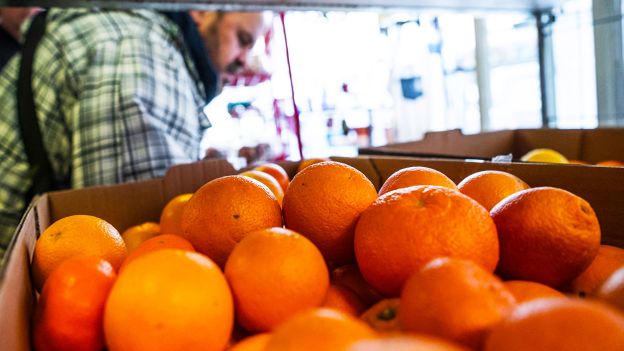
In the Brussels demo, funded by the country’s social welfare centre, members from approximately 60 small-revenue households get €150 every month for one yr – without having to make a contribution – to invest in 1 grocery store: BEES Coop. By means of suggests so considerably members are mainly purchasing dietary staples, with a small portion allotted to non-foods things these types of as soap and bathroom paper. Hache credits the intervention with increasing her diet plan and easing her stress ranges. “I can purchase organic and natural fruit and greens and bulk goods in the portions I want,” she suggests.
The project in Montpellier, supplemented by community and personal grants, gets closer to the objective of wealthier members contributing extra for their food items. For 1 year, just about every of the 400 individuals, 50 percent of whom reside in poverty, are essential to lead a voluntary volume between €1-150 (($1.1-159/£0.9-£133)regular, and will obtain €100 ($10/8£90) month-to-month, regardless of what they contributed. To stop the allowance from becoming misused, the citizens’ committee powering the project problem the resources in a regional forex that can be invested at five supermarkets throughout the town.
Emma Patterson, senior lecturer in community health nourishment at Stockholm’s Karolinska Institute, suggests the intervention is an superb way of addressing structural barriers like charge and accessibility. “There’s great proof to recommend working in a structural way is additional powerful than just offering data to individuals,” she suggests.
Having said that, Patterson cautions that by limiting the funds to be put in only in specific shops, access might continue to be a barrier. “To have a huge effect, you require to involve everyday supermarkets and make this offered to every person. Usually, you would be benefiting people now in a position to make added excursions to special stores. You would miss out on reaching out to the broader phase of the inhabitants that wants to be helped,” she claims.
Adequate foods is created to feed 10 billion people today, nevertheless much of the world’s population is inadequately nourished and, globally, hunger, meals insecurity and malnutrition are on the rise. Even prior to Russia’s invasion of Ukraine, which despatched world wide food items selling prices skyrocketing, 3.1 billion folks currently could not afford to pay for a healthier eating plan.
From the United kingdom to Spain to Germany to Latvia, meals bank demand from customers is soaring throughout Europe. It is really a equivalent story throughout the Americas. Food items banks in Canada have reported record-breaking visits to food banking companies, in Argentina food stuff banking institutions are unable to satisfy need and in the US food stuff financial institution use is up 1-third as opposed to just before the Covid-19 pandemic.
Peuch states possessing to talk to for foodstuff isn’t a dignified method and that food stuff help, when serving a part in extraordinary cases, simply cannot be a prolonged-phrase reaction to food items insecurity. “Often the condition suggests to us, ‘we have no foods challenge in our place because we have meals aid.’ But for us, food stuff help is not the proper to food,” he claims. “It only supplies minimal amount, and [when it comes to] high quality, individuals are unable to seriously pick.”
Patterson agrees it is critical for people to have the liberty to pick out their individual meals and for interventions to be built and produced with dignity in thoughts.
With food stuff insecurity a rising concern in the course of Europe, campaigners feel a window of chance to usher in adjustments may possibly be opening. “When you have to eat food stuff that you will not want to invest in, but you have to buy it for the reason that you you should not have a choice… this helps make folks knowledgeable,” says Peuch.
Research exhibit lower home profits is continuously affiliated with poorer food plan good quality, as very low-price tag meal plans depend on energy-dense but nutrient-bad food items. In Scotland, GPs have described soaring circumstances of malnutrition due to overreliance on these types of food items considering that the onset of the price tag-of-dwelling crisis. Inadequate nutrition is linked to the around the world rise of micronutrient deficiencies, weight problems and preventable diseases like coronary heart disease, stroke and type 2 diabetes.
Foodstuff insecurity is especially harmful to the wellness, improvement and wellbeing of little ones, whose nutritional requirements are large all through a time of immediate physical progress. Globally, childhood malnutrition is considered one particular of the greatest public health issues.
The pressure of very poor diet on health care methods is sizeable. A review in Belgium, for illustration, discovered healthcare fees and dropped efficiency charges thanks to excessive fat totalled €4.5bn ($4.8bn/£4bn) for each 12 months concerning 2013 and 2017.


